How to Rank Fast in Google
TL;DR: “Fast” wins come from upgrading pages you already have, matching intent in the title/H1/intro, adding internal links from high-authority pages, publishing low-competition FAQs, tightening GBP if you’re local, and getting 2–5 quick, relevant links from partners. Ship, index, measure, iterate.

What “rank fast” really means
Rapid ranking is shortest-path SEO: improve what’s closest to winning, and publish where competition is light. It’s not hacks—it’s speed of execution on proven levers: intent match, internal links, content depth, and a small burst of credible links.
Fastest levers (in order of impact/time)
- Upgrade existing pages that already have impressions.
- Add contextual internal links from homepage, hubs, and top posts.
- Publish 1–3 exact-question FAQ pages targeting low-KD queries.
- For local terms, tighten Google Business Profile and spark fresh reviews.
- Secure 2–5 relevant partner/supplier links to the target URL.
7-Day Sprint: from “stuck” to “moving”
Day 1 — Pick battles you can win
- In Search Console → Performance, sort pages by impressions where avg position = 10–30. These are your “almost there” targets.
- Choose 1–3 pages tied to money terms.
Day 2 — Intent-first on-page tune-up
- Rewrite title/H1/intro to mirror the dominant SERP intent (informational, commercial, local).
- Add a scannable outline: H2s that cover every sub-topic on page-one winners.
- Insert a comparison block, a short FAQ, and a clear CTA.
Day 3 — Internal link boost
- Add 5–10 contextual internal links from your homepage, category hubs, and any high-traffic posts to the target page.
- Use descriptive anchors (no stuffing), e.g., “fence repair in Grand Rapids.”
Day 4 — Net-new FAQ(s) where competition is low
- Pull 3–5 People Also Ask questions; choose ones with specific intent.
- Create individual FAQ pages (exact match in title/slug/H1, answer in sentence one).
- Link these FAQs to the related money page and vice versa.
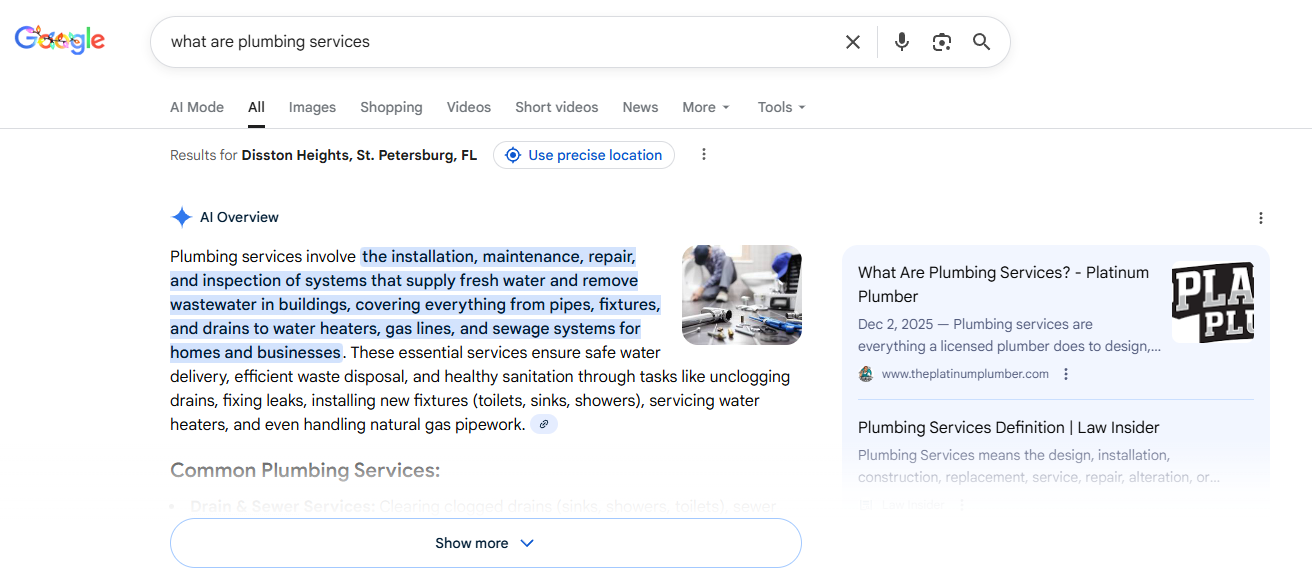
- Case example: We shipped a simple FAQ targeting a low-competition query—Cheapest time of year for tree removal—and it indexed and hit #1 fast because it exactly matched the question in the title, slug, and H1.
Day 5 — Local push (if applicable)
- GBP: verify categories, add services/products, upload real photos, post an update, and reply to 3 recent reviews.
- Ask 5 happy customers for specific reviews (service + city + outcome).
Day 6 — Quick, clean links
- Ask 3–5 partners/suppliers/associations for a simple “Customers/Partners” listing that links to your target page (editorial/contextual is best).
- Publish one mini case study and ask the customer to feature it on their blog with a link back.
Day 7 — Indexing & measurement
- Link new/updated pages from an already-crawled page (e.g., a hub).
- Ensure in sitemap; request indexing via URL Inspection in GSC.
- Track queries → page weekly; iterate sections based on movement.

What to do (and not do) for “speed”
Do
- Prioritize pages already earning impressions.
- Add real proof: screenshots, photos, brief case snippets.
- Keep publishing velocity steady for 2–4 weeks.
Don’t
- Expect page-one overnight on competitive head terms.
- Buy bulk links or use link schemes.
- Ship thin content or doorway city pages.
Schema note (keep expectations realistic)
Use FAQPage, HowTo, or LocalBusiness schema to clarify entities and eligibility for rich results—but understand schema by itself is not a big ranking lever. It won’t hurt; it just isn’t the reason you jump positions.
Simple on-page checklist (copy/paste)
- Exact intent reflected in Title / H1 / first sentence
- Scannable H2s covering all SERP sub-topics
- One comparison element (table or bullets)
- 5–10 contextual internal links pointing in
- 1–2 unique images/screens + brief case proof
- Short FAQ (2–4 Qs) mapped to PAA
- Clear CTA (call, form, or quote)
- In sitemap + requested indexing
Troubleshooting if nothing moves in 2–4 weeks
- Re-audit the live SERP: are you truly matching format/intent?
- Strengthen internal links from higher-authority pages.
- Add one new section that competitors have (pricing factors, step-by-step, vs. alternatives).
- Secure 1–2 more relevant editorial links to the exact URL.
- If the URL has history baggage, consider relaunching on a cleaner, related slug with a 301 from the old page.

“Fast” content types that win
- FAQ answers to exact questions (low KD, clear intent).
- Fresh “how-to” walkthroughs with original screenshots/video.
- Local service pages with before/after proof and city-specific FAQs.
- Short case snapshots that show outcome and link naturally to your money page.
Wrap-up
Ranking fast is about momentum: upgrade what’s close, interlink it, publish easy wins, tighten local signals, and add a handful of real links. Keep the feedback loop tight—ship, index, measure, adjust.

.svg)

.avif)